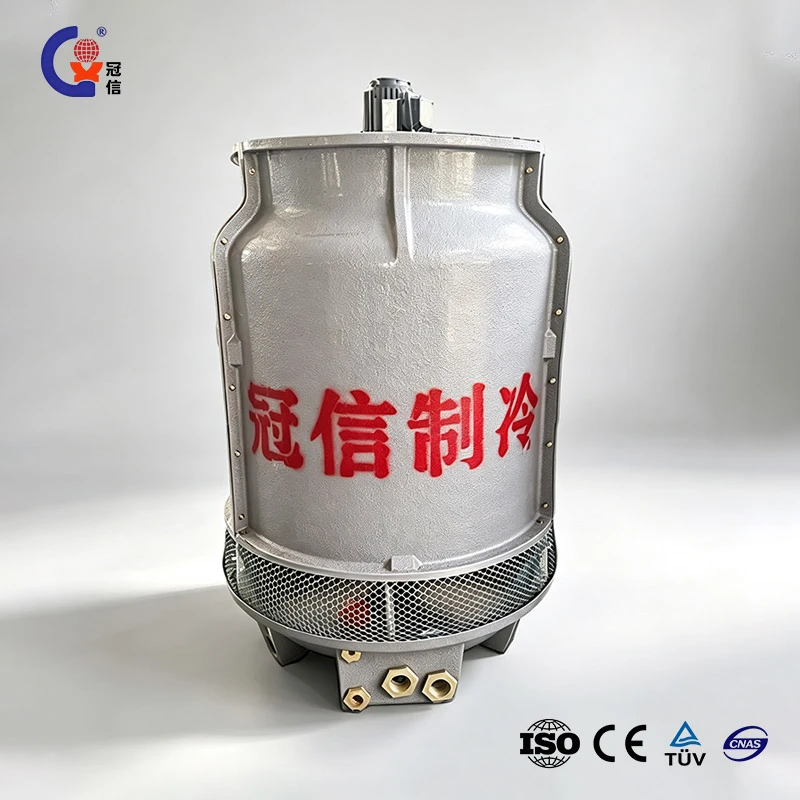
Cooling Towers
A cooling tower is essential industrial equipment for heat dissipation across numerous scenarios. It dissipates waste heat and cools circulating water for a wide range of industries, including power plants, manufacturing factories, chemical processing plants and large central air conditioning systems. For all facilities that rely on chilled water to cool production machinery, cooling towers are indispensable supporting units.
Product Overview
Cooling towers are heat rejection devices that discharge surplus heat generated by industrial production processes or HVAC systems into the ambient air. They are widely deployed in power generation, oil refining, equipment cooling and other heat-dissipation processes.
Working Principle
- Hot water produced by the production system is transported to the cooling tower via pipelines.
- Hot water flows through pipelines to the sprinkler heads, which evenly distribute water over the tower fill media.
- A motor-driven fan draws air through the tower, breaking falling water into tiny droplets to accelerate heat exchange.
- After heat exchange on the fill media, cooled water collects in the bottom water basin and circulates back to the production system for reuse.
Main Types of Cooling Towers
Open-circuit Cooling Tower
Process water makes direct contact with ambient air, enabling maximum evaporation and heat transfer efficiency.
Closed-circuit Cooling Tower
A built-in heat exchanger isolates process fluid from cooling water, effectively preventing water contamination.
Mechanical Draft Cooling Tower
Equipped with fans to force air circulation inside the tower, delivering stable high cooling efficiency under all operating conditions.
Natural Draft Cooling Tower
Driven by natural air convection without fans; mostly adopted for large-scale projects like power stations.
Hybrid Cooling Tower
Integrates the advantages of open and closed circuit structures to achieve optimal cooling performance and water saving.