If your industrial operation involves an industrial chiller, grasping its core basics enables you to operate and leverage the equipment more efficiently. This article comprehensively elaborates on the core concepts, working principles, main types, key components and typical industrial applications of industrial chillers. Read on for professional insights!
What Is a Process Chiller?
A process chiller is a professional cooling device designed to extract and remove heat from targeted cooling areas. It is widely deployed in diverse industrial processes that demand strict and precise temperature regulation to ensure operational stability and product quality.
Why Industrial Processes Require Precise Chiller Cooling
Temperature sensitivity is a core requirement for numerous industrial scenarios. Precision-dependent processes such as chemical synthesis reactions and semiconductor manufacturing and testing can only maintain stable reaction states and qualified product yields with accurate temperature control delivered by chillers.
In addition, continuous operation of industrial equipment inevitably generates cumulative heat. Without effective heat dissipation, excessive heat buildup will lead to equipment overheating, component aging and even permanent damage. Industrial chiller systems serve as essential cooling solutions to stabilize equipment temperature and extend service life.
Working Principle of Industrial Chillers
Industrial chillers achieve continuous cooling through a complete refrigeration cycle. They adopt refrigerant as the heat transfer medium to absorb heat from secondary cooling media and complete heat exchange with industrial process systems. The entire cyclic refrigeration process relies on the coordinated operation of four core components: compressor, condenser, expansion valve and evaporator.
First, the compressor compresses low-pressure gaseous refrigerant, rapidly raising its pressure and temperature to form high-temperature and high-pressure gaseous refrigerant. Next, the high-temperature refrigerant flows into the condenser, where it conducts heat exchange with ambient air or cooling water, releasing heat and condensing into liquid refrigerant.
Subsequently, the liquid refrigerant passes through the narrow passage of the expansion valve. As the flow space expands suddenly, the refrigerant pressure and temperature drop sharply, forming low-temperature and low-pressure gas-liquid mixed refrigerant.
Finally, the low-temperature refrigerant enters the evaporator, absorbing heat from the process cooling medium and fully evaporating into gaseous refrigerant. The gaseous refrigerant then flows back to the compressor to start a new refrigeration cycle, realizing continuous and stable cooling circulation.
Key Technical Parameters of Industrial Chillers
Selecting a suitable industrial chiller requires a clear understanding of core technical parameters. These indicators directly determine whether the equipment matches actual production needs. The key parameters are summarized as follows:
Temperature Range
The temperature range refers to the maximum and minimum operable temperature of the chiller’s circulating medium. For example, a temperature range of -40°C to 100°C means the equipment can deliver circulating fluid at temperatures between -40°C and 100°C, and all actual outlet temperature setpoints must fall within this interval.
Cooling Capacity
Cooling capacity defines the chiller’s heat removal capacity, which is affected by multiple factors including circulating medium type, heat exchanger structure design and medium flow rate. If the chiller’s rated cooling capacity is lower than the actual industrial heat load, it will be impossible to cool the process to the preset target temperature. Therefore, the required cooling capacity must be accurately calculated based on actual operating conditions before selection.
Refrigerant Type
Refrigerant is the core working medium circulating inside the chiller system. It absorbs heat through evaporation and releases heat through condensation to complete heat transfer and cooling. Different refrigerants feature distinct thermodynamic properties, which directly influence the equipment’s cooling capacity, operating pressure range, achievable temperature range and overall system safety. Meanwhile, the use of refrigerants is restricted by environmental protection regulations in various countries and regions, making compliant refrigerant selection essential.
Temperature Control Accuracy
Parameters such as ±0.1°C commonly seen in chiller specifications represent the equipment’s temperature control accuracy, referring to the temperature fluctuation range of the outlet circulating fluid. For temperature-sensitive production processes and precision equipment, chillers with higher control accuracy are required to eliminate temperature deviation and ensure process stability.
Cooling Method
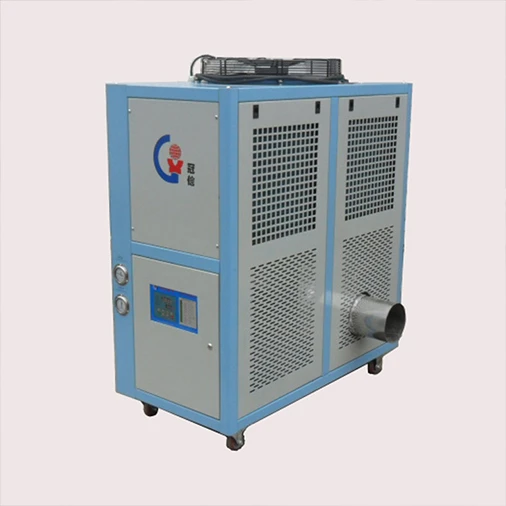
The cooling method refers to the way the chiller condenser dissipates heat to the external environment, divided into two mainstream types: air-cooled and water-cooled. Air-cooled chillers dissipate heat by driving ambient air through the condenser via fans. Water-cooled chillers rely on external cooling water to take away condenser heat and require supporting cooling tower systems for normal operation.
Core Components of Industrial Chillers
The refrigeration system of a process chiller consists of four indispensable core components, with auxiliary functional parts added in practical industrial applications to optimize operational performance:
Compressor
As the power core of the refrigeration cycle, the compressor compresses gaseous refrigerant to raise its pressure and temperature, providing power for refrigerant circulation and heat exchange. Common types of industrial compressors include centrifugal, scroll and screw compressors, applicable to different cooling capacity scenarios.
Condenser
The condenser is responsible for cooling and condensing high-temperature gaseous refrigerant into liquid refrigerant. The heat dissipation modes vary by chiller type: air-cooled chillers use fan forced air cooling, while water-cooled chillers adopt circulating cooling water from cooling towers for heat exchange.
Expansion Valve
With a narrow flow passage, the expansion valve is the pressure regulating core of the system. It reduces the pressure and temperature of liquid refrigerant through sudden volume expansion, preparing low-temperature medium for subsequent heat absorption and cooling. Electronic expansion valves (EEV) and thermal expansion valves (TXV) are the two most widely used types.
Evaporator
The evaporator is the core heat exchange component for industrial cooling. Low-temperature liquid refrigerant absorbs heat from the process circulating medium here and evaporates into gas, realizing the heat transfer from the production system to the chiller system and achieving the purpose of equipment and process cooling.
Classification of Industrial Chillers
Classification by Condenser Cooling Mode
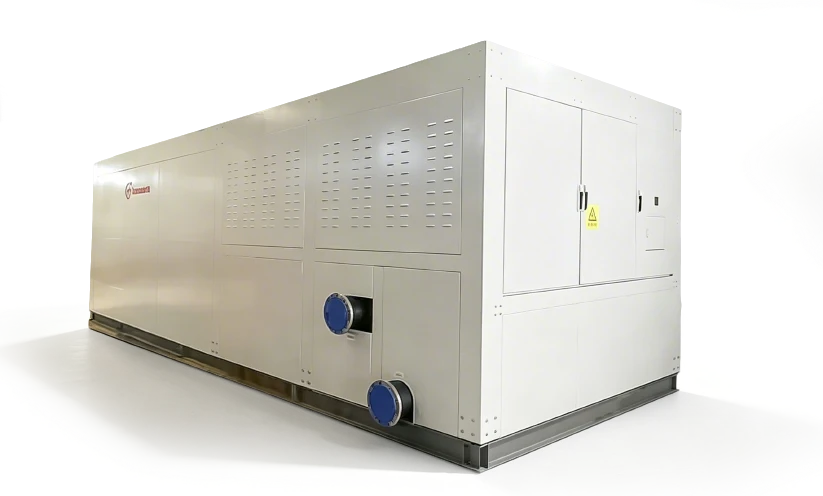
Based on condenser heat dissipation methods, industrial chillers are divided into water-cooled and air-cooled types. Water-cooled chillers rely on cooling water to absorb heat from high-temperature refrigerant, requiring supporting water towers, water pumps and pipeline systems. Though they occupy a larger floor area, they deliver high and stable cooling efficiency, suitable for large-scale long-term industrial operation.
Air-cooled chillers realize refrigerant heat dissipation through fan air convection, with no need for cooling tower supporting facilities. Their cooling efficiency is susceptible to ambient temperature, and the cooling performance will decline significantly in high-temperature environments.
Classification by Compressor Type
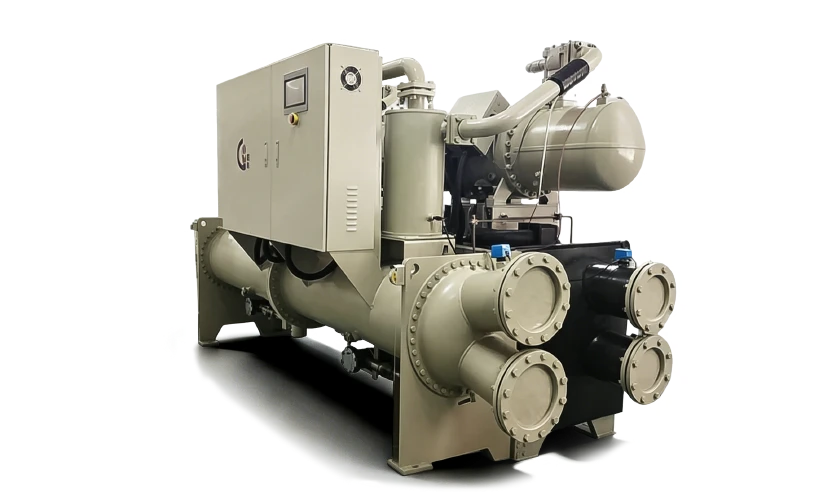
Screw Chillers: Equipped with screw compressors that compress refrigerant through screw rotor operation, screw chillers are available in both water-cooled and air-cooled versions. Featuring large cooling capacity and stable operation, they are mostly applied in large industrial production sites.
Scroll Chillers: Adopting scroll compressors composed of dynamic and static scroll structures, scroll chillers are compact in size, low in energy consumption and flexible in operation, making them ideal for small and medium-sized industrial and commercial scenarios.
Centrifugal Chillers: Centrifugal compressors generate strong centrifugal force through high-speed rotation to compress refrigerant. With ultra-high cooling power and large heat removal capacity, they are specially used for large-scale industrial refrigeration and central cooling projects.
Typical Industrial Applications of Chillers
Industrial chillers are widely used in precision manufacturing, chemical production, electronic testing and many other fields. The mainstream application scenarios are as follows:
Laser Cutting Processing
Long-term continuous operation of laser cutting machines will generate massive heat on laser generators and cutting heads. Uncontrolled heat accumulation will cause thermal stress damage to precision components, leading to equipment failure and high maintenance and replacement costs. Chillers provide continuous and stable cooling to ensure the precision and stability of laser processing equipment.
Injection Molding Production
In the injection molding process, rapid and uniform mold cooling is the key to improving demolding efficiency and ensuring consistent batch quality of finished products. Industrial chillers accurately control mold temperature, effectively shortening molding cycles, improving production efficiency and avoiding product defects such as deformation and shrinkage marks caused by uneven cooling.
Semiconductor Testing
Semiconductor components have extremely strict temperature sensitivity. To verify product performance and stability under extreme temperature conditions, manufacturers use professional semiconductor chillers to provide constant and precise temperature environments for performance testing, ensuring product qualification rate and reliability.
Chemical Reactions
Most chemical synthesis reactions require strict constant-temperature environments to control reaction rate, prevent side reactions and ensure reaction safety. In actual production and experiments, chillers are matched with jacketed reactors to accurately regulate reaction temperature, meeting the temperature requirements of various complex chemical reactions.